Swap Rate

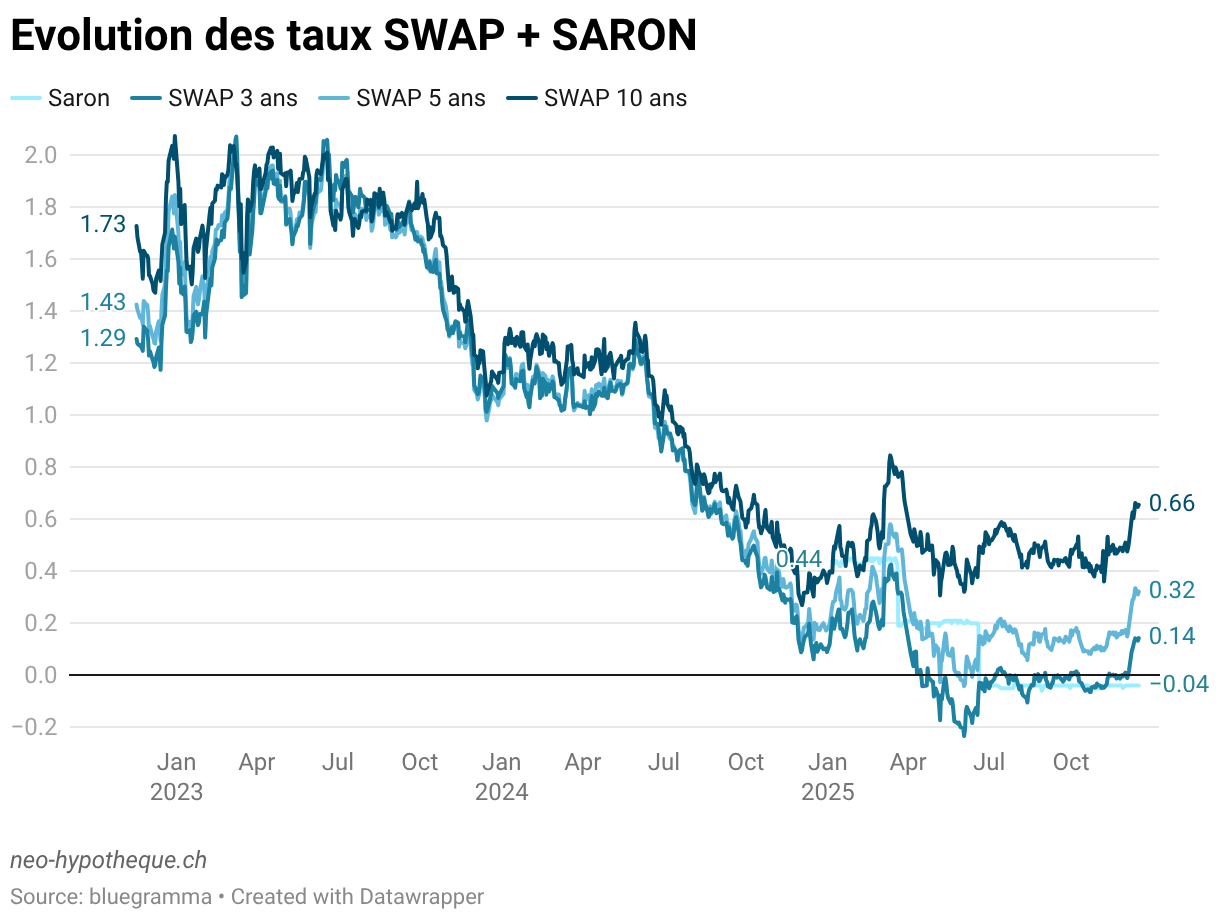
The Swiss franc swap rate (CHF Swap Rate) is the most important indicator for anyone looking to take out a fixed-rate mortgage. It represents the market’s underlying benchmark, determining the trend in long-term interest rates over several years.

Header image

Swap Rate

  • -0.04%

    Saron

    Saron

  • 0.646%

    Swap 3 ans

    Swap 3 ans

  • 0.737%

    Swap 5 ans

    Swap 5 ans

  • 0.879%

    Swap 10 ans

    Swap 10 ans

Les taux d’intérêt représentés ne sont donnés qu’à titre indicatif et indiquent les meilleures conditions actuelles. 

What Is a Swap Rate?

The term “swap” means “exchange”. In finance, an Interest Rate Swap (IRS) is a contract between two parties to exchange interest payments over a specified period (for example, 10 years).

In simple terms for the mortgage market:

  • It is the cost at which a bank borrows on the capital markets so it can guarantee you a fixed rate over a long period (5, 10, or 15 years).
  • It reflects market participants’ expectations about how benchmark interest rates (such as SARON) will change over the swap period. The more they expect rates to rise, the higher the swap rate.
The Fixed-Rate Formula

The fixed mortgage rate offered by a bank is always constructed as follows:

Fixed Mortgage Rate = Swap Rate (depending on term) + Bank Margin (0.6–1%)

  • Swap Rate: This is the cost of the raw material (money) for the bank. This rate is public and varies daily according to the market.
  • Bank Margin: This is the premium charged by the financial institution to cover its operating costs and client risk, and to generate profit (generally between 0.6% and 1%). This margin is negotiable.
Concrete Example: For a 10-year mortgage, the bank uses the 10-year CHF Swap Rate. If this swap rate is 0.59% and the bank applies a margin of 0.75%, the final mortgage rate will be 1.34%.

Compare interest rates now

Swiss Mortgage Rate Comparison

English 🇺🇸🇬🇧